history
Trinity Episcopal Church, located at 703 West 3rd Avenue in Pine Bluff, Arkansas,
is the oldest Episcopal church in the state and a significant historical and architectural landmark.
Founding and Early Years (1859–1870)
Congregation Established: The congregation was founded in 1859, initially meeting in various churches and homes in Pine Bluff. The group was organized by the Reverend Robert Trimble, who became the first resident Episcopalian rector in Pine Bluff. The congregation was initially named St. John’s Parish but was later renamed Trinity Episcopal Church, inspired by guidance from members of Trinity Church in New York City.
Land Acquisition and Construction:
In 1865, the congregation purchased a lot at the corner of West 3rd Avenue and Oak Street. They ordered thirty-one stained glass windows, and the cornerstone for the church was laid in 1866. Construction of the Gothic Revival-style church, made of reddish-brown brick, took place between 1866 and 1870. The building was completed at a cost of approximately $18,000, which was fully paid before the first worship service was held on Christmas Day, 1870.
Unique Features: The church is notable for its Gothic architecture, characterized by a square buttressed tower, buttressed side walls, and lancet-arched stained glass windows. A distinctive feature is the burial chamber beneath the chancel, housing early parishioner Cornelia Bell Roane, who died in 1862.
Altar and Reredos:
The altar and reredos (decorative elements behind the altar) were crafted in 1870 by Bell and Bocage of Pine Bluff. These were used at Trinity until 1931, when they were donated to St. Paul’s Episcopal Church in McGehee, Arkansas. They were returned to Trinity in 1955 and later donated to Holy Trinity Episcopal Church in Hot Springs Village in 1987.
Growth and Resilience
(1871–20th Century)
Consecration and Expansion: The church was consecrated in 1871 by Bishop Pierce, who praised the congregation’s “energy, zeal, and thorough self-sacrifice.” Over time, Trinity expanded to occupy an entire city block, with additional buildings and a school. The church also acquired deeds to three neighboring lots.
Notable Parishioners: The early congregation included prominent Pine Bluff citizens, such as judges, legislators, mayors, doctors, lawyers, newspaper editors, merchants, planters, military officers, and even a governor. Their contributions helped establish Trinity as a community cornerstone.
Surviving Challenges: Trinity endured significant challenges, including the Civil War, seven subsequent wars, economic depressions, a major flood, two minor earthquakes, a serious fire, and the ice storms of 2000. Despite these, the church remained a “living house of faith,” as described in Oasis: A History of Trinity Episcopal Church, Pine Bluff, Arkansas by Jacquelyn Layton Stuart.
Symbolic Oak Tree: In 1886, the ladies of the church purchased an oak tree for 35 cents, which stood in front of the bell tower for 120 years. By 2006, the tree was diseased and removed, but parishioner Richard Bettison crafted necklaces, desk sets, and candle holders from its wood, preserving its legacy.
Architectural and Cultural Significance
Gothic Revival Design: The church’s architecture features a steeply pitched roof, short transepts, a gabled portico with stepped buttresses, and a large square corner tower with a crenelated top. The interior boasts a painted wooden ceiling with exposed beams supported by slender beveled columns, allowing natural light from the stained glass windows to fill the space. An ornately carved Carrara marble altar is a prominent feature.
National Register of Historic Places: Trinity Episcopal Church was added to the National Register of Historic Places in 1974, recognizing its architectural and historical significance.
Renovation:
The church underwent renovation in 1997 by Witsell Evans Rasco, ensuring its preservation.
Community Impact and Legacy
Role in the Community: Trinity has been a spiritual and cultural centerpiece of Pine Bluff for over 150 years. It remains an active member of the Episcopal Diocese of Arkansas, fostering a vibrant community committed to sharing God’s love.
Mission Work: In 1866, Rev. Robert Trimble’s ministry led to the establishment of St. Andrew’s, a Black Episcopal mission church in Pine Bluff, built in 1906 on property donated by Wiley Jones, a prominent businessman and founding member of St. Andrew’s.
Grace Episcopal Church: On Trinity Sunday in 1959, Trinity announced the purchase of land to establish Grace Episcopal Church, a new mission in southwest Pine Bluff, expanding its influence.
Historical Documentation: The book
Oasis: A History of Trinity Episcopal Church, Pine Bluff, Arkansas by Jacquelyn Layton Stuart chronicles the church’s history from 1859 to 2009. It highlights Trinity’s resilience and its role as a community “oasis in the desert,” a phrase coined by Rev. Trimble in 1866.
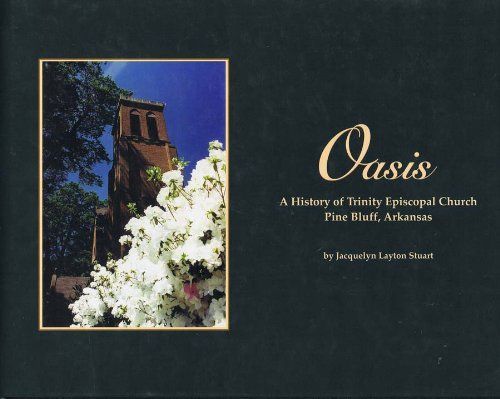
If you wish to purchase a copy of this book, there are copies still available in the church office. They are $10 per book.